ANC vs Transparency Mode in an Open Office: Which Setting Actually Helps?

Introduction
Open-plan floors created a strange new skill: choosing an audio mode before choosing music. The headphones on most desks now offer at least two, and the wrong one costs either concentration or a colleague’s goodwill.
Active noise cancelling promises silence. Transparency mode promises awareness. Marketing treats them as a feature list, yet in a shared office they solve genuinely different problems on different days.
The confusion runs deeper because brands name the same idea differently. Ambient Sound, Aware Mode, and Transparency all describe passing outside audio through the microphones, and shoppers compare them as if they were separate features.
This guide sorts the modes by the noise you actually face at a desk. It covers what each one can and cannot remove, how the naming maps across brands, and which situations call for switching.
Quick Answer

Use active noise cancelling against steady mechanical noise. Air handling, fan hum, elevator rumble, and street traffic sit in the low frequencies where cancellation performs best, and the effect on focus is immediate.
Use transparency mode when people are the reason you wear headphones. It keeps chatter at a manageable level while you still hear your name, a question, or a fire alarm, which keeps you part of the room.
Neither mode erases nearby conversation on its own. Speech reduction comes mostly from a good physical seal, so fit decides more than the marketing. Our best noise cancelling headphones roundup covers models built around that seal.
What to Look For
Start with the dominant noise at your desk. Sit for ten minutes without headphones and name the loudest steady source, then the loudest irregular one. A humming vent points you to cancellation, while a sales team on calls points you to isolation plus a quiet playlist.
Check how fast you can switch modes. A single tap or a squeeze beats digging through an app when someone stops at your desk. Models that force a phone app for the switch discourage people from using transparency at all.
Look closely at the fit rather than the cancellation rating. Over-ear cups with a full seal and eartips in the right size block more speech than any electronics does. Most brands ship several tip sizes, and the largest one that stays comfortable usually seals best.
Finally, weigh call performance separately from listening performance. Office use means meetings, and microphone arrays vary far more than noise cancelling does between flagship models. Our best earbuds for phone calls guide focuses on that side.
Top Options
Sony markets its pass-through as Ambient Sound, and its over-ear WH-1000XM line pairs strong cancellation with granular ambient levels. That granularity suits people who want a little awareness rather than a full open ear.
Apple uses Transparency on AirPods Pro, with quick switching through a stem press. The mode aims for a natural tone, which makes conversation feel closer to speaking without earbuds. Deep integration with iPhone and Mac appeals to Apple-heavy offices.
Bose calls its version Aware Mode, and the QuietComfort family remains a common choice for long wearing comfort. Samsung labels the same idea Ambient sound on Galaxy Buds, which fits Android desks and Samsung phones.
A quieter option is passive isolation with no electronics at all. Well-sealed wired earbuds or over-ear cups reduce speech and cost far less, at the price of a cable and no mode switching. For a broader form-factor decision, see our wireless earbuds vs over-ear headphones comparison.
Feature Comparison

The table below matches modes to the situations that actually occur on an open floor. The final column notes what the mode cannot fix, which is where most disappointment starts.
| Office situation | Best mode | Why it works | What it will not fix |
|---|---|---|---|
| Constant HVAC or fan hum | Active noise cancelling | Steady low frequencies suit cancellation | Sudden bangs and door slams |
| Nearby colleague on a call | ANC plus a good seal | Physical isolation blocks most speech | Speech directly beside your ear |
| Teammates stopping by often | Transparency | You hear and answer without removing anything | Sustained loud chatter |
| Your own video calls | Transparency | Hearing your voice keeps volume natural | Poor microphone quality |
| Deep focus work session | ANC with quiet audio | Lowest total distraction | Visual interruptions at your desk |
| Walking through the building | Transparency | Safety awareness of doors and carts | Wind noise outdoors |
| Shared desk with a neighbor | ANC, low volume | Contains leakage from your side | A colleague’s leaky headphones |
The pattern is that cancellation buys depth of focus while transparency buys social speed. Most office days need both, which is why one-tap switching matters more than a small cancellation advantage.
How to Choose
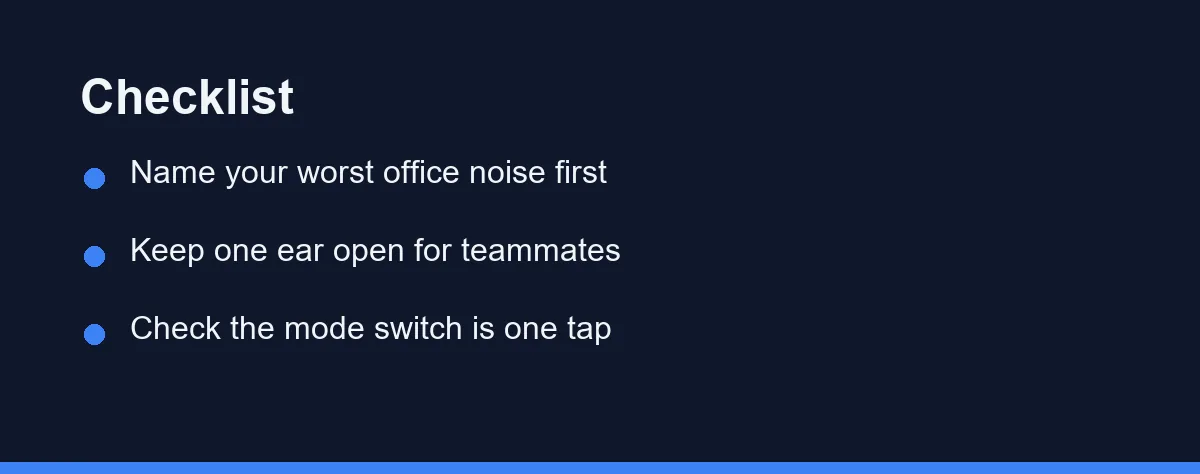
Decide first whether your office problem is noise or people. Noise problems favor cancellation and a strong seal, while people problems favor transparency and fast switching. Buying the wrong side of that split leaves an expensive pair of headphones in a drawer.
Next, consider your role. Engineers and writers in long focus blocks tend to live in cancellation, while managers and support staff need to stay reachable. Anyone taking many calls should prioritize microphones over both modes.
Then think about comfort across a full day. Over-ear cups warm up in summer, and some people feel pressure from strong cancellation. If either bothers you, well-sealed earbuds with a light transparency setting often work better than a flagship over-ear model.
Finally, test in the actual room before committing. Retail demos happen in quiet shops, which flatters every product. Many brands and retailers publish return windows, so check the current policy on the official Sony, Bose, or Apple site before ordering.
Pricing: What to Expect
Flagship over-ear models from Sony, Bose, and Apple sit at the top of the market, and prices move with each generation and seasonal sale. Confirm current numbers on the official product pages rather than trusting an old review. As of 2026, previous-generation flagships often remain on sale at a clear discount.
Mid-range wireless earbuds now include both cancellation and a pass-through mode, which was a flagship-only combination a few years ago. For office use, that tier often covers the need, since the main job is steady hum and moderate chatter.
Remember the accessories in the total. Replacement eartips, a case, and a USB-C cable are small costs, though foam tips in particular can improve isolation more than a step up in model tier. Employers with an equipment budget may cover part of this, which is worth asking before you buy.
Common Mistakes to Avoid
The biggest mistake is expecting cancellation to erase voices. It reduces the hum around speech and makes conversation less piercing, but a colleague two meters away still comes through. People who buy for that promise usually feel cheated by an otherwise good product.
Another mistake is living in cancellation all day and missing the room. Colleagues stop asking questions when they cannot reach you, and that quiet costs more than it saves over a quarter. Scheduling open-ear windows keeps you approachable.
A third mistake is raising the volume to mask chatter. Loud audio in a noisy room is the real hearing risk, not the cancellation circuit. Lower the volume, improve the seal, and let isolation do the work.
Finally, do not ignore the switching gesture when you shop. A mode you cannot reach in one second is a mode you will not use. Check how the control works on the specific model, since it changes between generations.
Verdicts by Use Case
For focus-heavy roles in a loud building, active noise cancelling with a strong over-ear seal wins. Pair it with quiet instrumental audio and agreed availability hours so teammates still reach you.
For collaborative and support roles, transparency mode is the better default. It keeps you in the conversation while still trimming the edge off room noise, and it prevents the earbud-out shuffle every ten minutes.
For heavy meeting schedules, prioritize microphone quality and pick transparency for your own speaking comfort. A call-focused model beats a flagship listening model in this job.
For hot-desking and hybrid workers, choose earbuds with a fast mode switch and a compact case. Portability and one-tap control matter more than the last decibel of cancellation. Anyone weighing gym use for the same pair should read our best sweat resistant earbuds for the gym guide first.
Conclusion
Noise cancelling and transparency are not competing features but complementary tools for a shared floor. Cancellation buys depth against machines, while transparency buys speed with people.
Pick your headphones around fit, switching speed, and microphone quality, then use both modes deliberately through the day. Confirm current pricing and return policies on the official sites, and test the pair in your own office before the window closes. The right setting changes hourly, and the best product is the one that lets you change it without thinking.
FAQ
Does noise cancelling block voices in an open office?
Only partly, because active noise cancelling works best on steady low-frequency sound. It handles air conditioning, server fans, and traffic rumble well. Speech sits in a higher, less predictable range, so most of the reduction there comes from the physical seal of the earcup or eartip rather than the electronics.
What is the difference between transparency mode and simply taking the earbuds out?
Transparency mode pipes outside sound through the microphones so you hear the room while the earbuds stay in place. That keeps your audio, your call, and your seal ready the moment the conversation ends. Removing an earbud pauses playback on many models and invites a longer interruption.
Is it bad for your ears to use noise cancelling all day?
Noise cancelling itself does not damage hearing, and it often helps because you stop raising the volume to beat background noise. The real risk is sustained high volume, whichever mode you use. Occasional breaks help with ear fatigue and pressure sensitivity that some people report.
Do open offices need over-ear headphones or are earbuds enough?
Over-ear models usually cancel more and signal "do not interrupt" more clearly. Earbuds win on portability, comfort in warm rooms, and quick conversations. Teams with frequent drive-by questions often prefer earbuds in transparency mode over full over-ear isolation.
Which mode is better for video calls at a shared desk?
Transparency mode usually sounds more natural, since hearing your own voice keeps you from shouting. Noise cancelling helps you concentrate on the other speaker in a loud room. Microphone quality matters more than either mode, so check call-focused models first.
Some links may be affiliate links. We may earn a commission at no extra cost to you.
This article was written with AI assistance. It is researched and fact-checked, not based on personal hands-on testing unless explicitly stated.


Comments
Post a Comment