IP Ratings Explained: What IPX4 and IP68 Really Mean for Earbuds and Watches
A Rating That Sounds Like a Promise
For gym use, IPX4 is the sensible floor and IPX5 adds margin for rain, while swimmers should choose a 5ATM watch rating over any IP code alone. If you take a device to the beach, a rinse habit protects it more than an extra digit.
Product pages treat IP ratings as reassurance. Waterproof appears in the marketing copy, IPX4 appears in the specification table, and the two are describing very different things.
The rating itself comes from a formal standard, IEC 60529, and it means something precise. What it does not do is predict how your device behaves in a hot shower, a chlorinated pool, or two years from now.
Understanding the code takes about five minutes and saves a replacement purchase. It also explains why manufacturers exclude liquid damage from warranties on devices they advertise as water resistant.
This guide breaks down each digit, compares the ratings you actually see on earbuds and watches, and sets out where the lab test stops matching real life.
The Two Digits, and What Each One Covers

An IP code carries two digits after the letters. The first covers solids such as dust, and the second covers liquids.
The solids digit runs from zero to six. Six means dust-tight, and five means dust-protected, which allows a small ingress that does not affect operation.
The liquids digit runs further, from zero to eight, with a specialised nine for high-pressure hot water. Each number describes its own test rather than a point on a single scale.
An X replaces a digit the maker never tested. IPX4 says nothing about dust, and reading the X as a zero misjudges the product in the other direction.
Two details matter more than the numbers. Laboratories test new devices in fresh water at controlled temperatures, and seals age with heat, impact, and time.
That is the gap between a rating and a guarantee. The code describes a moment on a test bench, not the state of a device you have carried in a pocket for eighteen months.
Common Ratings, Side by Side
The table covers the ratings that appear most often on consumer audio and wearables.
| Rating | What the test covers | Typical device | What it does not promise |
|---|---|---|---|
| IPX2 | Dripping water at a slight tilt | Budget over-ear headphones | Rain, sweat during exercise |
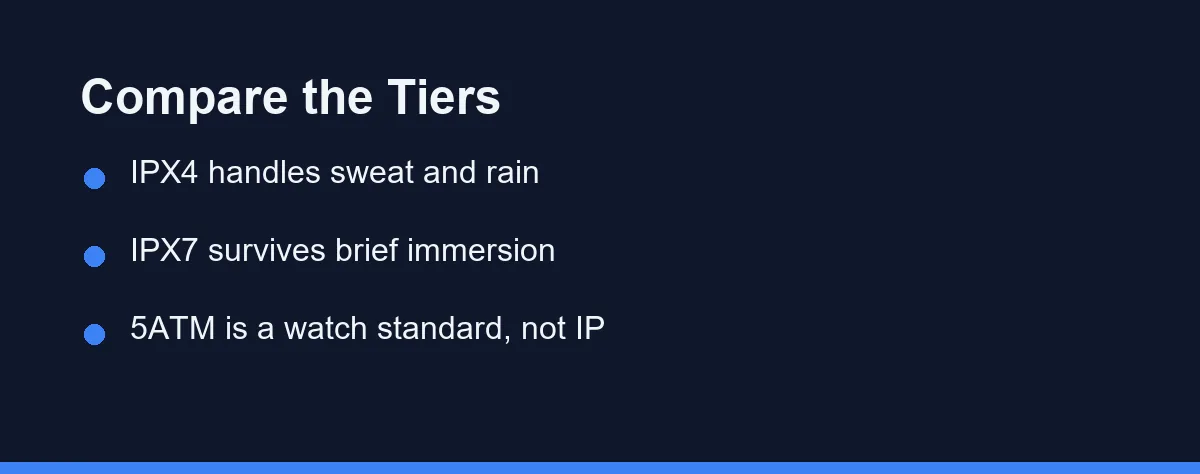
| IPX4 | Splashing from any direction | Gym earbuds, most fitness bands | Immersion, jets, submersion in a sink |
| IPX5 | A low-pressure jet from any angle | Outdoor speakers, rugged buds | Sitting underwater for any length of time |
| IPX7 | Immersion to one metre for thirty minutes | Premium earbuds, many smartwatches | Pressurised jets, hot water, salt water |
| IP68 | Dust-tight plus immersion beyond one metre | Flagship phones and watches | A depth the maker has not specified |
| IP54 | Limited dust plus splashes | Portable speakers, work gear | Any immersion at all |
| 5ATM | Pressure resistance under a watch standard | Swim-capable smartwatches | Diving, high-speed water impact |
Two rows cause most of the confusion. IPX7 and IP68 sound like the same guarantee, and the second digit alone hides the fact that IP68 depth varies by manufacturer.
The other trap is IPX5 against IPX7. Neither one contains the other, so a device rated only for immersion may still fail under a shower head.
Why Higher Numbers Do Not Stack
Most people assume the liquid digits form a ladder. Pass eight, and seven through one come free.
The standard does not work that way. The jet tests and the immersion tests simulate different pressures and angles, and passing one says little about the other.
Manufacturers that ran both tests publish both results. A specification listing IPX5 and IPX7 together tells you far more than a single higher number.
Depth is the second soft spot. IPX8 and the eight in IP68 mean immersion beyond one metre under conditions the maker defines, so the real figure sits in the manual rather than the code.
Look for the sentence next to the badge. Responsible makers state the tested depth and duration, and a badge without that sentence is marketing rather than specification.
What the Lab Test Leaves Out
Fresh water at room temperature is the test condition. Everything you actually expose a device to sits outside that definition.
Salt water attacks seals and contacts, and a rinse in clean water afterwards matters more than the rating did. Chlorinated pool water sits in the same category.
Hot showers are worse than they look. Steam carries fine water vapour, and the heat expands the air inside the housing, which drives moisture past gaskets that would hold at room temperature.
Soap and shampoo reduce surface tension, which lets water reach seams that plain water would run off. Sunscreen and insect repellent degrade the adhesives and coatings.
Impact matters too. A device dropped on tile can lose its seal without any visible damage, and the rating on the box no longer describes what you own.
Age does the rest. Adhesive seals, mesh vents, and rubber gaskets all lose their properties over a few years of heat and flexing.
Sweat, Charging, and the Failures People Actually Have
Sweat is the most common liquid a pair of earbuds meets, and it is harsher than rain. The salts stay behind after the water evaporates, and they corrode contacts and clog acoustic mesh.
Wipe them down after a session rather than dropping them into the case wet. A dry microfibre cloth removes most of the risk in about ten seconds.
Charging contacts are the real failure point. Water bridging a charging pin causes corrosion quickly, which is why phones now refuse to charge until the port dries.
Give the same courtesy to earbuds and watches. Dry the contacts and the charging cradle before connecting anything.
The case usually carries a lower rating than the buds, and often no rating at all. Rain on the buds is fine, and rain into an open case is a different event.
If sweat resistance is your main concern, our roundup of sweat-resistant earbuds for the gym covers the fit and rating combinations that hold up in training.
Watches Use a Different System Entirely
Smartwatches often skip IP codes and quote pressure instead. A 5ATM marking comes from ISO 22810, the standard for water-resistant watches, and refers to a static pressure test.
Static is the operative word. Swimming adds dynamic pressure from movement, which is why makers rate 5ATM for swimming rather than for diving or high-speed water sports.
Diving has its own standard, ISO 6425, and watches built to it carry an explicit marking. A fitness watch without that marking is not a dive instrument regardless of its pressure figure.
Many wearables now publish both an IP code and a pressure rating. Read them together, because the IP digit tells you about dust and the pressure rating tells you about swimming.
Water lock modes matter on any swim-capable watch. Turning one on before entering the pool prevents accidental touches and ejects water from the speaker afterwards.
For swim tracking specifically, our guide to fitness trackers for swimming covers which ratings pair with usable pool metrics.
What to Do When Something Does Get Wet
The first minute matters more than the rating did. Power the device off if it still responds, and resist the urge to check whether it works.
Never charge a wet device. Current across damp contacts corrodes them quickly, and that damage outlasts the water itself.
Dry the outside with a soft cloth, paying attention to ports, charging pins, and speaker grilles. Tilt the device so water runs out rather than deeper in.
Use the water eject function if the device has one. Watches and phones play a low tone that pushes water out of the speaker cavity, and it works better than shaking.
Skip the rice. Rice adds dust and starch without drawing meaningful moisture out, and heat sources such as hair dryers and radiators damage adhesives and batteries.
Give it time in moving air at room temperature instead. Twenty-four hours before charging is a reasonable rule for anything that took a real soaking.
Salt water needs one extra step. Rinse briefly in clean fresh water first, because dried salt crystals keep corroding long after the device looks dry.
If audio sounds muffled afterwards, the mesh is probably holding water. That usually clears within a day, and a persistent change means it is time to contact support rather than to keep drying.
Which Rating Fits Your Use

Gym and running: IPX4 is the sensible floor, and IPX5 adds margin for heavy rain. Rinse nothing, wipe everything, and dry the contacts before charging.
Swimming or pool laps: Look for a watch rating rather than an IP code alone. 5ATM with the maker naming swimming explicitly is the usable combination.
Beach and boat trips: Prioritise a rinse habit over a rating. Salt water damages devices that passed every fresh-water test in the laboratory.
Building sites and workshops: The solids digit earns its place here. IP54 or better keeps grinding dust out of a device that will never see immersion.
Commuting in wet weather: IPX4 handles rain and IPX7 covers the dropped-in-a-puddle scenario. Our roundup of wireless earbuds lists which sit at each tier.
Devices already two years old: Assume the rating has degraded and behave one tier more cautiously than the badge suggests. Seals do not announce their retirement.
What Water Resistance Costs, and Who Pays
Higher ratings raise the manufacturing cost, and that shows up in the price of otherwise similar models. Figures move by brand and region, so confirm current pricing on the maker’s official site.
The cost that surprises people arrives later. Most warranties exclude liquid damage explicitly, even on devices advertised with an IP rating, and a claim usually turns on internal moisture indicators.
Read the warranty language before relying on the badge. A rating describes what the product survived in a laboratory, and a warranty describes what the company will pay for.
That gap is the strongest argument for habits over specifications. Wiping sweat off, drying contacts, rinsing after salt water, and keeping the case shut protect a device far more reliably than an extra digit ever will.
FAQ
What does the X in IPX4 actually mean?
The X means the maker never tested that digit, not that the device fails it. IPX4 tells you about splashes and says nothing about dust, while IP54 covers both. Treat an X as missing information rather than a zero, and look for a dual rating if dust matters for your use.
Does a higher IP number include everything below it?
Not reliably. The liquid digits describe different tests rather than a single scale, so a device that survives thirty minutes underwater has not necessarily faced a pressurised jet. Makers that tested both usually publish two ratings, such as IPX5 and IPX7 together.
Can I shower or swim with an IPX7 device?
No. Laboratories run the test in fresh water at room temperature, so salt water, chlorinated pools, soap, and hot showers all fall outside the rating. Steam is the worst case, because heat expands the air inside the housing and pushes moisture past the seals.
Is sweat harder on earbuds than rain?
Sweat carries salts and oils that attack seals, meshes, and contacts more aggressively than plain water does. A gym pair benefits from an IPX4 rating as the floor, plus a wipe with a dry cloth after each session. Never charge earbuds while the contacts are still damp.
What does 5ATM mean on a smartwatch?
5ATM comes from a watch standard rather than the IP system, and it points to pressure resistance during swimming rather than diving. Serious diving needs a watch built to the dive standard instead. Check whether the maker names swimming explicitly, because pressure ratings alone rarely tell the whole story.
Some links may be affiliate links. We may earn a commission at no extra cost to you.
This article was written with AI assistance. It is researched and fact-checked, not based on personal hands-on testing unless explicitly stated.
Comments
Post a Comment