AirPods Pro as a Hearing Aid: Who It Helps and Who Needs a Doctor

For Mild to Moderate Loss, Often Yes
If you are an adult with perceived mild to moderate hearing loss, AirPods Pro 2 or AirPods Pro 3 can serve as an over-the-counter hearing aid. The FDA authorized Apple’s hearing aid software on September 12, 2024. AirPods Pro 3 run up to 10 hours on a charge with the feature on.
They are not a fit for everyone. Severe loss, sudden changes, or hearing that is much worse in one ear call for a doctor first, and anyone under 18 needs a prescription device.
What the Hearing Aid Feature Actually Does
The feature turns the earbuds into a sound amplifier tuned to your hearing. The Apple setup guide for Hearing Aid says it is intended for people 18 or older with perceived mild to moderate hearing loss.
It works only in Transparency mode. In that mode the microphones pick up the room, and the software boosts the frequencies your test showed you struggle with.
You can fine-tune the result. Apple lists sliders for amplification, tone and balance, plus Ambient Noise Reduction for fan or road noise.
A second feature, Media Assist, applies the same profile to music, video and calls. Unlike Hearing Aid, it works in every noise control mode, including noise cancellation.
The Five-Minute Hearing Test and What Your Number Means
Setup starts with a hearing profile. You can use an audiogram from a hearing professional, or take Apple’s own test with the earbuds in.
The Apple Hearing Test guide says the test takes about five minutes. It plays tones from 250 Hz to 8 kHz, some of them very quiet, and you respond to each one you hear.
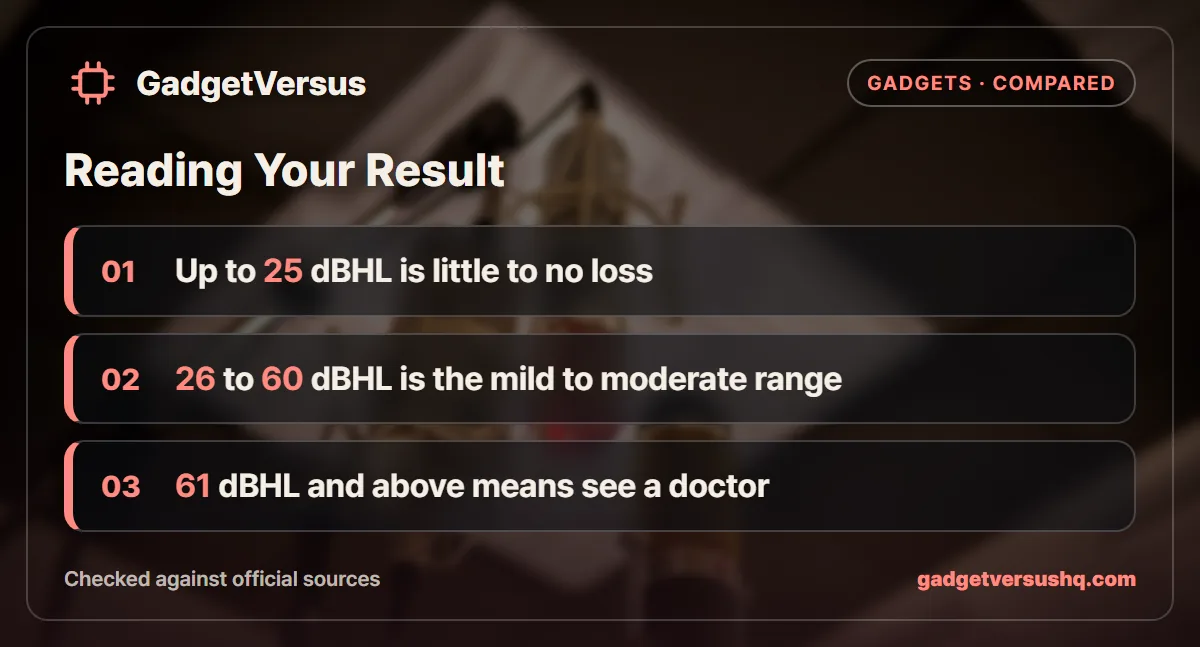
The result is one number per ear, in decibels of hearing level, or dBHL. It averages your hearing across the frequencies that matter most for speech, and a higher number means sounds must be louder for you to hear them.
| Result per ear | What Apple says it indicates | Suggested next step |
|---|---|---|
| Up to 25 dBHL | Little to no hearing loss | No hearing aid needed |
| 26 to 40 dBHL | Mild hearing loss | Hearing Aid or Media Assist may help |
| 41 to 60 dBHL | Moderate hearing loss | Hearing Aid or Media Assist may help |
| 61 to 80 dBHL | Severe hearing loss | Talk to a doctor |
| Sudden change in hearing | Not a test band | Talk to a doctor |
Apple flags conditions that skew the test. Skip it if you had a cold, sinus infection or ear infection in the last 24 hours, or spent time somewhere loud such as a concert.
AirPods Pro Against Dedicated Hearing Aids
The FDA created the over-the-counter hearing aid category in a rule that took effect on October 17, 2022. Apple’s hearing aid software was authorized in that category.
| Feature | AirPods Pro Hearing Aid | Other OTC hearing aids | Prescription hearing aids |
|---|---|---|---|
| Intended users | Adults 18+, mild to moderate loss | Adults 18+, mild to moderate loss | Any age, including severe loss |
| Who fits it | You, with an iPhone or iPad | You, following the maker’s steps | A hearing professional |
| Hearing test | 5-minute Apple test or an audiogram | Varies by product | Professional audiogram |
| When it amplifies | Transparency mode only | Whenever it is worn | Whenever it is worn |
| Battery per charge | Up to 10 hours on AirPods Pro 3 | Varies by product | Varies by product |
| Also an earbud | Yes, for music and calls | Varies by product | Varies by product |
The biggest practical difference is visibility and habit. AirPods look like ordinary earbuds, which may remove one reason people delay treatment.
The FDA notes that only about one-fifth of people who could benefit from a hearing aid seek help. A device people already own may close some of that gap.
What the FDA Study Found
The FDA authorization rested on a clinical study of 118 people with perceived mild to moderate hearing loss. It ran at several sites in the United States.
The FDA announcement reports that people who fitted the software themselves saw a perceived benefit similar to those fitted by a professional. Measured amplification and speech understanding in noise were comparable between the groups.
The study observed no adverse events related to the device. That is reassuring, but it covers the intended group only, not people with severe loss.
Signs You Should See a Doctor First
The FDA lists red flags that rule out self-fitting until a doctor has looked. Its guide to OTC hearing aids recommends seeing a doctor, preferably an ear, nose and throat specialist, if any apply.
- Your hearing changed suddenly in the past 6 months.
- You saw blood, pus or fluid coming from your ear in the past 6 months.
- You get dizzy or feel spinning or swaying.
- Your hearing is worse in one ear.
- You hear ringing or buzzing in only one ear.
These signs can point to conditions that amplification would mask. Treating the cause first matters more than turning up the sound.
One Test Result Worked Through
A sample result shows how the rules combine. Assume the Apple test returns 32 dBHL for the left ear and 45 dBHL for the right.
Both numbers sit inside the mild to moderate range Apple supports. On the table alone, Hearing Aid looks like a fit.
The gap between the ears changes the answer. The right ear is 13 dBHL worse than the left, and the FDA lists worse hearing in one ear as a reason to see a doctor first. A doctor visit comes before setup, not after.
Battery is the second check. Assume a waking day of 16 hours with Hearing Aid on throughout. At up to 10 hours per charge on AirPods Pro 3, that day needs 16 / 10, or 1.6 charges, so plan at least one break in the case.
A result like 30 dBHL in both ears, with none of the red flags, is the clearer case. That listener can set up Hearing Aid and adjust it over a few days.
Getting a Good Result From the Setup
The seal matters more than most settings. Apple says the test needs a complete seal, and AirPods Pro 3 ship with foam tips in five sizes, including an XXS option.
Take the test somewhere quiet, with about five minutes free of talking, fans or air conditioning. Background noise can make your result look worse than it is.
Change settings gradually. Apple notes that amplified sound takes time to get used to, so small adjustments over several days work better than big jumps.
The settings live on the AirPods themselves. Hearing Aid keeps working with the most recent profile even when your phone is out of range.
Where AirPods Fall Short as All-Day Aids
Battery is the clearest limit. Apple lists up to 10 hours with the feature on AirPods Pro 3, while a full waking day is longer than that.
Comfort is another. Earbuds that seal the ear canal are built for a few hours of listening, so try a full day before you rely on them.
Situations vary too. Conversation Boost is best for one-on-one talk with the person directly in front of you, which is not the same as a busy dinner table.
Finally, availability depends on where you live. Apple says Hearing Aid availability varies by country or region, so check its feature availability list before buying for this purpose.
Hearing Protection Is the Other Half
The same earbuds can protect hearing as well as boost it. The Apple hearing health page lists noise at 90 dBA for a lawn mower and 105 dBA for live events.
Apple says Hearing Protection works in environments as loud as 110 dBA. It is not suitable for sustained sound louder than that.
For anyone with early hearing loss, protecting what remains is as important as amplifying it. Our guide on how loud is too loud through earbuds covers safe listening levels in daily use.
Who Should Use AirPods and Who Should Not

Adults with mild to moderate loss in both ears: AirPods Pro 2 or 3 fit well. Take the test, set up Hearing Aid, and adjust slowly.
People whose loss is worse in one ear: See a doctor first. The FDA lists this as a red flag for self-fitting.
Anyone with severe or profound loss: Choose prescription hearing aids. Apple’s own test guidance points these results to a doctor.
Teenagers and children: Not a fit. The feature is intended for people 18 and older.
People who mostly struggle with TV dialogue: Try Media Assist and TV settings first. Our guide on why TV dialogue is hard to hear covers fixes that cost nothing.
Wearers who need sound all day: Plan for charging breaks, since 10 hours rarely covers a full waking day.
Start With the Test, Not the Purchase
If you already own AirPods Pro 2 or 3, the first step costs nothing. Take the five-minute test and see where your numbers fall.
If both ears land between 26 and 60 dBHL and no red flags apply, Hearing Aid is worth a trial. If not, take the result to a hearing professional, along with any audiogram you already have.
FAQ
Can AirPods Pro really be used as a hearing aid?
For adults with perceived mild to moderate hearing loss, AirPods Pro 2 and AirPods Pro 3 can work as an over-the-counter hearing aid. The FDA authorized the software on September 12, 2024. People with severe loss, or anyone under 18, should see a doctor instead.
How long does the AirPods Pro hearing test take?
Apple says the Hearing Test takes about five minutes. It plays tones from 250 Hz to 8 kHz and gives one result per ear in dBHL, so plan for a quiet room and a good ear tip seal.
How long does the AirPods Pro hearing aid battery last?
Apple lists up to 10 hours in Transparency with the Hearing Aid feature on a single charge for AirPods Pro 3. A long day of wear will usually need a top-up in the charging case.
Can I use an audiogram from my audiologist instead of the Apple test?
Yes. Apple lets you set up Hearing Aid with a Hearing Test taken on an iPhone or iPad, or with an audiogram from a hearing healthcare professional.
Does the hearing aid feature work with noise cancellation on?
No. Hearing Aid amplifies surrounding sound only in Transparency mode. Media Assist, which tunes music and calls to your hearing, works in all noise control modes.
Sources
- Apple Support: Set Up and Use Hearing Aid and Media Assist on AirPods Pro — checked 2026-11-11
- Apple Support: Take a Hearing Test With AirPods Pro 2 or AirPods Pro 3 — checked 2026-11-11
- Apple: AirPods Pro Hearing Health — checked 2026-11-11
- Apple: AirPods Pro 3 — checked 2026-11-11
- FDA: FDA Authorizes First Over-the-Counter Hearing Aid Software — checked 2026-11-11
- FDA: OTC Hearing Aids, What You Should Know — checked 2026-11-11
Some links may be affiliate links. We may earn a commission at no extra cost to you.
How this article was made: it was drafted with AI assistance from the official sources listed above, and its figures were checked against those pages on the dates shown. It is not based on personal hands-on testing.
Comments
Post a Comment