What Qi2 Means on a Charger and Which Phones Get the Full 25W

Qi2 Means Magnets First and the Watts Depend on Your Phone
Qi2 is a magnetic wireless charging standard, and the ring of magnets is the part that always works. The wattage is conditional. A pad badged Qi2 delivers 15W, a pad badged Qi2 25W can reach 25W, and the Wireless Power Consortium says that faster tier takes a phone from 0 to 50 percent in about 30 minutes.
Whether you ever see 25W depends on your phone and on the adapter behind the pad. Apple lists 25W peak power for iPhone 17 Pro but 22.5W for iPhone 16 Pro, on the same charger.
The Box Now Carries Two Qi2 Badges and They Are Not the Same
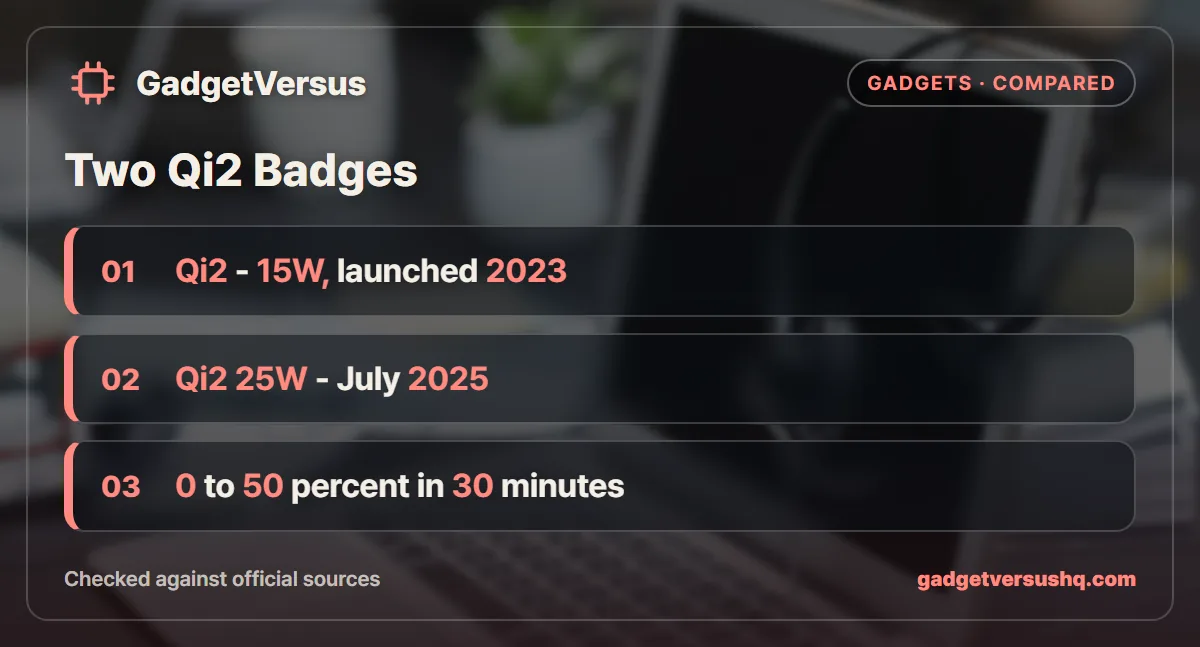
Qi has been around since 2010, and the consortium counts more than 13,000 certified products. Qi v2.0, sold as Qi2, arrived in 2023 and added the magnetic alignment that made wireless charging predictable.
The second badge is newer. Qi v2.2.1 launched in July 2025 under the name Qi2 25W, and the consortium describes it as nearly 70 percent more charging power than Qi2.
So two pads on the same shelf can both say Qi2 and differ by 10W. The number after the word is doing the work, and a plain Qi2 badge means 15W.
What Each Charging Label on the Shelf Actually Promises
Labels drift between marketing and certification, which is why a pad can advertise magnets without being certified at all. The table separates what a badge guarantees from what it merely suggests.
| Label on the box | Magnets included | Peak wireless power | What your phone needs | Adapter it expects |
|---|---|---|---|---|
| Qi, no number | No | 5W to 15W depending on pad | Any Qi phone since 2010 | Most USB-C bricks |
| Qi2 | Yes, certified ring | 15W | Qi2 phone or Qi2 Ready case | 20W or greater |
| Qi2 25W | Yes, certified ring | 25W | A phone that accepts the faster tier | 30W Apple, 45W PPS Samsung |
| Apple MagSafe Charger | Yes | 25W peak on iPhone 17 Pro | Listed iPhone models only | 30W or greater, 15V and 2.0A |
| Samsung Qi2 Ready setup | In the case, not the phone | 15W on the single pad | Galaxy S25 with a magnet case | 25W or greater |
| Magnetic but uncertified | Yes, no certification | Unstated | Anything, at slow speeds | Unstated |
The bottom row is where most bargains live. Magnets are cheap to add and certification is not, so a magnetic pad with no Qi2 logo is telling you something by omission.
Your Phone Sets the Ceiling Long Before the Pad Does

Apple publishes a model by model table, and it is the clearest evidence that the pad is not in charge. iPhone 17 Pro, iPhone 17 Pro Max, iPhone 17, iPhone 16 Plus and iPhone 16 Pro Max reach 25W peak power.
Two models that sound identical land lower. Apple lists 22.5W peak for iPhone 16 and iPhone 16 Pro, and 20W peak for iPhone Air.
Older hardware sits on the earlier tier entirely. Apple lists 15W peak for iPhone 17e and for iPhone 15 and earlier, and those need only a 20W adapter to reach it.
The practical lesson is to look up your own model before shopping. A 25W pad on a 15W phone is not faster in any measurable way, and the extra outlay buys headroom for the phone after next.
Peak is also the right word to notice. These figures describe the best case at a low state of charge, and every phone tapers as the battery fills.
Qi2 Ready Is a Case Standard, Not a Phone Standard
Samsung uses a separate phrase, and it changes what you have to buy. The Galaxy S25 series is sold as Qi2 Ready, meaning the phone body has no magnets and a Qi2 Ready certified case supplies them.
That distinction matters at the checkout. A Qi2 pad plus an ordinary case gives you a wireless pad with no alignment help, which is the exact problem Qi2 was invented to fix.
Samsung then splits its own accessories the way the standard does. Its single magnetic pad is a 15W device, while its 25W magnetic charger reaches that figure only with a 45W adapter or a higher PPS supply at 20V.
The Adapter Behind the Pad Is the Part People Forget

Every wireless figure on this page assumes a power adapter that can feed it. Apple is explicit that 25W peak needs a 30W or greater adapter rated at 15V and 2.0A or higher.
Drop to a 20W brick and the same puck on the same phone charges at 15W. Nothing is broken and no error appears, which is why people blame the pad.
Apple adds one sequencing detail worth copying. Plug the charger into power before you place the phone on it, so the charger can verify that maximum power is safe to deliver.
Why the Same Pad Charges Slower on a Warm Afternoon
Wireless charging turns some of its energy into heat by design, and heat is what a phone protects itself from. Apple notes that software may limit charging above 80 percent if the battery gets too warm.
Accessories change the picture too. Apple lists a drop to 10W for iPhone 17 Pro and iPhone 17 Pro Max, and 7.5W for the iPhone 16 family, when a USB-C or Lightning accessory is connected at the same time.
A thick case, a card wallet, or direct sun on a desk all push the same direction. If you want the fast number reliably, give the pad a cool surface and nothing between the magnets. Our guide to whether charging overnight is bad covers the separate rules wireless pads deserve.
How to Check That a Pad Is Certified Rather Than Merely Magnetic
Certification is checkable, which makes it the one claim on the box you never have to trust. The consortium keeps a public product database of Qi certified devices, listed by brand and model number.
Search the model number printed on the pad or its packaging, not the marketing name. Sellers rename the same hardware for each storefront, and the model number is what certification is issued against.
An absent listing is not proof of a bad pad, but it does mean nobody independent has measured it. At that point the wattage claim is a seller writing a number on a box.
The stakes are practical rather than theoretical. Uncertified magnetic pads have no obligation to hold the alignment tolerance, and a slightly off centre coil charges slower while running warmer.
The Magnets Buy You an Accessory Ecosystem, Not Only Alignment
Alignment is the headline, but the ring is also a mounting system. Once a phone snaps into a known position, wallets, tripods, car mounts and battery packs can all attach without a clamp.
Battery packs show how the two roles combine. Samsung lists its magnetic battery pack as Qi2 certified at 15W wireless and 25W wired, so the same accessory is slow when stuck to the back of a phone and fast when you plug it in.
That gap is normal rather than a defect. Wireless transfer loses energy as heat across the coil gap, and a cable does not, which is why every magnetic pack quotes two numbers.
Read those two numbers before you judge a pack as slow. A 15W wireless figure beside a 25W wired figure describes one device behaving in two situations.
Which Qi2 Setup Fits the Way You Charge
Overnight beside the bed: Buy the 15W Qi2 pad and stop there. Speed is worthless while you sleep, and a cooler charge is easier on the cell. The magnets matter here mainly because a nudged phone no longer wakes up empty.
Desk charging between meetings: This is the case that justifies Qi2 25W. Thirty minutes on a break is the window the consortium describes as 0 to 50 percent, and the faster tier turns a habit into a real top up.
Travelling with one bag: Match the pad to the adapter you already carry. A 30W multi port charger can feed a Qi2 25W pad and a laptop only if it can hold both, so read the per port split before you pack.
Galaxy S25 owners: Budget for the case as part of the charger. Without a Qi2 Ready case there is no magnetic alignment, and you have paid Qi2 prices for a plain pad.
Car mounts and vents: Magnets are the feature and watts are secondary. Vent mounted pads run hot in summer, and a phone that slows above 80 percent on a dashboard is behaving exactly as documented.
Reading the Watt Figure on the Box Before You Pay for It
Three numbers decide what you get, and they are rarely printed together. The pad rating, your phone model figure, and the adapter output all have to line up, and the lowest one wins.
Check your phone first, since it is the number you cannot change. Then buy the adapter that matches, then the pad, and confirm current pricing on the official site before you order a bundle.
Anything that says magnetic without saying Qi2 is asking you to take alignment on trust. That is a fair trade at 5W beside a bed and a poor one at desk speeds. If the pad will live on a laptop dock, our note on telling USB-C cables apart explains why the cable in the box also has a say.
FAQ
Is Qi2 the same thing as MagSafe?
Not quite. Qi2 is the open standard from the Wireless Power Consortium, and MagSafe is the Apple implementation it was modelled on. An iPhone works with a certified Qi2 pad, but Apple reserves its highest wireless figures for its own charger paired with a 30W adapter.
Will a Qi2 charger work with a phone that is not Qi2?
Yes, for slow charging. Qi certification has covered phones since 2010 and a Qi2 pad still falls back to that older handshake. What an older phone cannot do is hold itself in the magnetic ring, so alignment goes back to guesswork.
Do I need a magnetic case to use Qi2 on a Samsung phone?
For the Galaxy S25 series, yes. Samsung sells those phones as Qi2 Ready, which means the magnets live in the case rather than the body, and a Qi2 Ready case is what unlocks magnetic alignment on its 15W pad.
Why does my Qi2 charger deliver 15W instead of 25W?
Usually the adapter. Apple lists 25W peak only with a 30W or greater adapter rated 15V and 2.0A, and Samsung lists 25W on its magnetic pad only with a 45W PPS adapter. A 20W brick caps most of these setups at 15W.
Does fast wireless charging wear out a phone battery faster?
It is slower and warmer than a cable, so heat management matters more than speed. Apple notes that software may limit charging above 80 percent if the battery gets too warm, which is the system protecting cell life rather than a fault.
Sources
- Qi Wireless Charging standards overview — checked 2026-09-07
- How to use your MagSafe Charger with iPhone — checked 2026-09-07
- Samsung Qi2 Single Magnetic Wireless Charger — checked 2026-09-07
Some links may be affiliate links. We may earn a commission at no extra cost to you.
How this article was made: it was drafted with AI assistance from the official sources listed above, and its figures were checked against those pages on the dates shown. It is not based on personal hands-on testing.
Comments
Post a Comment