Why Your Smartwatch Calorie Count Is Almost Always Wrong
The Figure People Trust Most and Should Trust Least
Calories are calculated rather than measured, so treat the number as a trend, not a total. If you eat back exercise calories, assume roughly half of what the app suggests, and if you lift, ignore the readout entirely.
Your watch shows 612 calories after a workout, printed with the same confidence as the time of day. That precision is the problem, because it hides how much guesswork sits behind the number.
Steps get counted. Heart beats get counted. Calories get calculated, and a calculation is only as good as the assumptions feeding it.
Most owners never learn which parts of their fitness data are measured and which parts are modelled. That distinction changes how much weight each figure deserves.
This guide separates the two, shows where the calorie model breaks down by activity, and explains how to get real value from a number that will never be exact.
What the Sensor Can and Cannot See
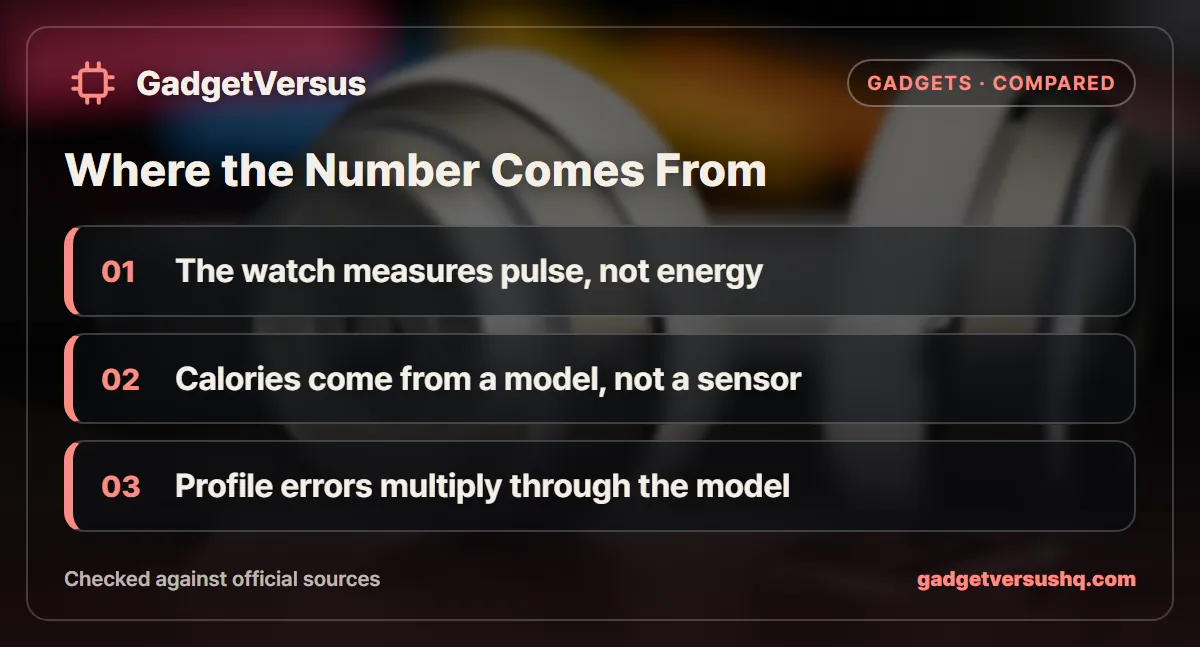
A wrist wearable shines a green light into your skin and reads how much bounces back. Blood absorbs that light, so the reflection pulses with each heartbeat, and the watch turns that rhythm into a heart rate.
That is the whole of what the optical sensor knows. It does not sense muscle load, oxygen use, or effort, and it has no view of what your body burns.
Calories then come from a formula. The watch feeds your heart rate, movement pattern, age, weight, height, and sex into a model that predicts energy expenditure, and prints the result.
A laboratory measures the same thing very differently. Indirect calorimetry captures the air you breathe out and compares oxygen going in against carbon dioxide coming out, which reflects actual metabolism.
Nothing on your wrist does that. The gap between a measured value and a predicted one explains almost every complaint about calorie accuracy.
Where the Model Goes Wrong
The first error source is you. Your resting metabolic rate can sit well above or below the average for your profile, and the model has no way to learn your true baseline.
Fitness level compounds this. A trained runner moves at a given pace with a lower heart rate and better efficiency, so an equation built on population averages will misread that same pulse.
Heart rate itself responds to more than effort. Caffeine, heat, dehydration, poor sleep, and stress all push it upward, and the model reads the extra beats as extra work.
A 2017 Stanford Medicine study of seven wrist wearables on 60 volunteers put numbers on this. Six of the seven read heart rate with an error under 5%. None measured energy burn well, and the best device was off by an average of 27% while the worst missed by 93%.
That study is old enough that sensors have improved since. The structural problem has not changed, because the calorie figure still comes from a prediction rather than a measurement.
Active Calories and Total Calories Are Different Claims
Two numbers appear in most fitness apps, and mixing them up creates half the confusion. Total calories include everything your body spends in a day, including the large amount it spends simply staying alive.
Active calories cover only the extra burn above that baseline. A one hour walk might show 200 active calories while the daily total climbs past 2,000, and both figures describe the same day.
Brands draw this line differently. Some subtract your estimated resting burn for the workout window, and others use a looser threshold, which is one reason two watches disagree so sharply.
Ring trackers and watches split here as well, and our comparison of a smart ring against a smartwatch covers how differently the two form factors handle activity data.
Check which number your app shows before you compare anything. Comparing an active figure from one device against a total from another produces a difference that means nothing.
How Wrong, and in Which Direction

Errors are not random. Each activity type bends the estimate a predictable way, which makes the table below more useful than a single accuracy percentage.
| Activity | What the watch senses | Usual error direction | Why it happens | Better approach |
|---|---|---|---|---|
| Steady outdoor running | Pulse plus GPS pace and distance | Closest to reality, modest over-read | Two independent inputs agree, so the model has more to work with | Trust the trend, ignore the exact total |
| Indoor cycling | Pulse only, arms mostly still | Under-reads for hard efforts | Legs do the work while the wrist stays quiet | Use the bike power meter if there is one |
| Weight training | Pulse between and during sets | Heavy under-read | Short intense sets raise effort without a sustained pulse rise | Log sets and volume rather than calories |
| Rowing and swimming | Pulse through moving water or grip | Erratic, often too low | Water and tight grip disturb the optical reading | Use a machine readout or a strap where allowed |
| HIIT and circuit classes | Rapid pulse swings | Over-reads the recovery periods | Heart rate lags effort, so it stays high while you rest | Compare class to class, never class to run |
| Hot weather sessions | Elevated pulse from heat load | Over-reads across the board | The body raises heart rate to cool itself, not to move you | Expect summer numbers to run high |
| Stressful desk day | Elevated resting pulse | Small but steady over-read | Stress mimics mild exertion at the wrist | Treat non-workout burn as background noise |
Steady cardio sits at the top for a reason. When pace, distance, and pulse all point the same way, the model has corroborating evidence and lands nearer the truth.
Strength work sits at the bottom for the opposite reason. The single input that the watch trusts most goes quiet exactly when the effort is highest.
The Feedback Loop That Causes Real Harm
An inflated calorie figure matters most for people who eat by it. Fitness apps often add your recorded burn back to a daily food allowance, which turns a modelling error into extra food.
Run the Stanford figure through a normal week. At the best device’s 27% average error, a 600 calorie workout could be off by 600 × 0.27 = about 162 calories. Five sessions a week puts the gap near 810 calories, which is more than a full meal.
If the error runs high, those calories go back on the plate without ever being spent. The estimate does not have to be wild to matter, only repeated.
The error runs the other way for lifters. A watch that reports 90 calories for a demanding session can make strength work look pointless next to a jog, which pushes people away from training they benefit from.
Neither outcome comes from a broken device. Both come from treating an estimate as an account balance.
Getting Value From an Imperfect Number
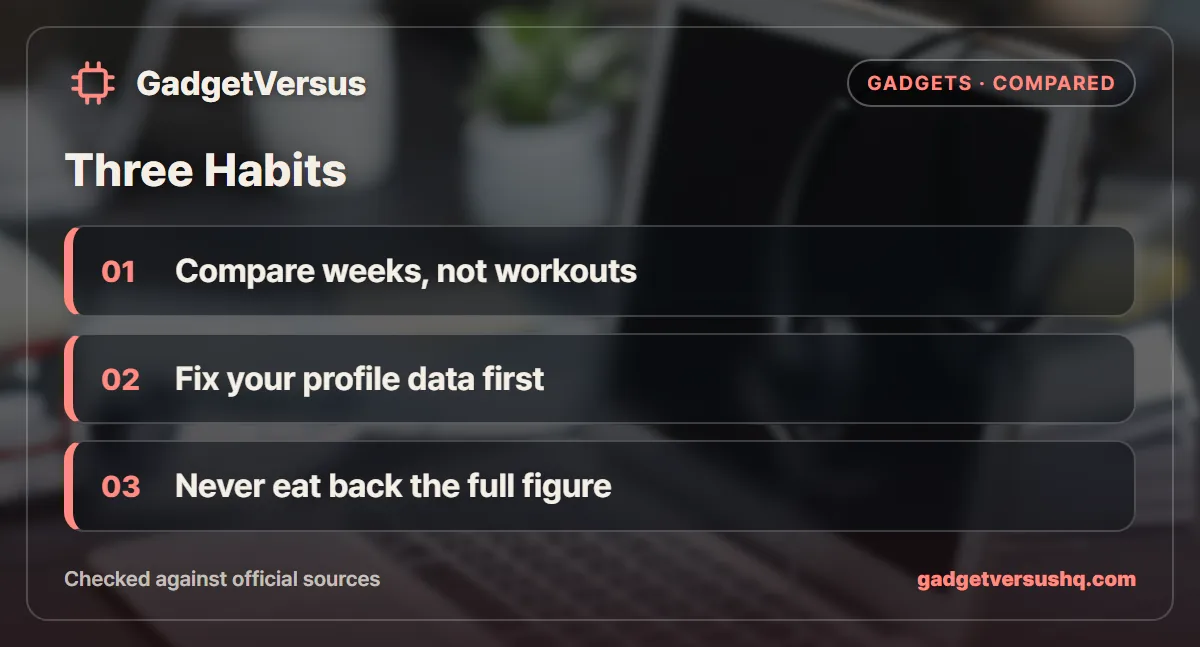
Fix your profile first, since the model starts there. Apple lists height, weight, sex, and age as the inputs its watch uses to estimate calories, so an outdated weight or a default age quietly skews every calculation afterwards.
Then calibrate stride if your watch offers it. Apple’s calibration guide asks for about 20 minutes of walking or running at a normal pace on flat, open ground, and says this can improve calorie accuracy in the Workout app.
Set your resting heart rate correctly, or let the watch learn it over a few nights of wear. Sleep tracking feeds that baseline on many models, and our look at how accurate smartwatch sleep tracking is explains what those overnight readings can and cannot establish.
Then change what you compare. The same watch making the same error on the same activity still shows real change, so this Tuesday against last Tuesday carries information that the raw total does not.
Never compare across brands. Two devices use different models, different thresholds, and different definitions, so the difference between them tells you about software rather than about your body.
Use effort as a cross check. If a session felt harder than last week and the number came out lower, believe your legs and check whether heat, caffeine, or a loose strap disturbed the reading.
Strap fit deserves attention here. A watch worn loose or over a wrist bone lets light leak in, and the resulting pulse errors flow straight into the calorie figure.
When a Chest Strap Actually Helps
A chest strap reads the electrical signal of the heart rather than a light reflection. That input is cleaner, especially during intervals and lifting where wrist readings lag or drop out.
Better input produces a better estimate. It does not produce a measurement, because the calorie model still applies population assumptions to your personal metabolism.
Runners and cyclists gain the most from the swap. Our chest strap and smartwatch heart rate comparison covers where the accuracy difference shows up during real sessions.
Power meters go further for cyclists. A power meter measures work in watts at the pedals, which is a physical quantity rather than a prediction, and that makes it the closest thing to a true training measurement most people can buy.
Running power figures do not carry the same authority. Those come from estimates built on pace, cadence, and vertical movement, so they inherit their own modelling assumptions.
Who Should Care About the Gap
The person eating back exercise calories: This matters to you more than to anyone else. Treat the reported burn as roughly half of what the app suggests you can eat, or stop logging exercise against food entirely.
The lifter: Ignore the calorie readout completely. Sets, reps, and load track your progress, and no wrist device measures the work you just did under a bar.
The runner chasing consistency: Your numbers are the most trustworthy of the group. Use weekly totals as a training load signal, and stop reading individual sessions too closely.
The casual walker: The daily total is directionally useful and precise in no way at all. A rising trend over a month means something, while a 40 calorie difference between two days does not.
The person switching brands: Expect your numbers to jump on the changeover day. Start a fresh baseline, and resist comparing the new watch against months of history from the old one.
The competitive age group athlete: Move to measured inputs where you can. A power meter, a chest strap, and an occasional lab test give you data that a wrist estimate cannot approach. Our guide to smartwatches against dedicated fitness trackers helps decide what to carry on training days.
Mistakes That Make the Gap Worse
Wearing the watch loose is the most common one. The sensor needs steady skin contact, and a strap that slides during a workout produces dropouts that the model fills with guesses.
Leaving stale profile data in the app comes next. People change weight and never update the figure, which shifts every calorie estimate for months afterwards.
Trusting the highest number across your devices is a third. A phone, a watch, and a gym machine will all disagree, and picking the friendliest total is a decision about mood rather than data.
The final mistake is quitting over the inaccuracy. A rough estimate that consistently reflects effort still guides training well, provided nobody mistakes it for a measurement taken in a lab.
FAQ
My heart rate reading looks accurate, so why would the calories be wrong?
No. Heart rate and energy burn are two different jobs, and wrist sensors handle the first far better than the second. A watch can read your pulse within a few beats and still miss the calorie figure by a quarter, because the conversion from pulse to energy relies on assumptions about you rather than measurements.
Does my watch underestimate strength training?
Usually yes, and lifting is the hardest case for a wrist device. Short heavy sets raise effort without raising heart rate much, so the watch reads a quiet pulse and reports a small burn. Rest periods between sets pull the average down further.
Why do two brands report different calories for the same workout?
They rarely match, because each brand uses its own model and its own definition of an active calorie. Two watches on the same wrist during the same run can differ by hundreds of calories, and neither figure carries an official audit.
Will a chest strap fix the calorie number?
A chest strap improves the pulse input, which helps, though it does not remove the modelling error. You get a better estimate rather than a measured value, since true energy burn needs a lab mask that samples oxygen and carbon dioxide.
If the number is unreliable, what should I do with it?
Track the trend instead of the total. The same watch on the same activity makes consistent errors, so week to week changes still carry information even when the absolute figure is off. Treat the number as a training score rather than a food budget.
Sources
- Stanford Medicine: Fitness trackers accurately measure heart rate but not calories burned — checked 2026-11-14
- Apple Support: Calibrate your Apple Watch for improved Workout and Activity accuracy — checked 2026-11-14
Some links may be affiliate links. We may earn a commission at no extra cost to you.
How this article was made: it was drafted with AI assistance from the official sources listed above, and its figures were checked against those pages on the dates shown. It is not based on personal hands-on testing.
Comments
Post a Comment