Garmin vs Coros for Running in 2026: Which Watch Fits Your Training?

Breadth Against Battery
The short answer is Coros for long battery life and simple menus, and Garmin for maps, multisport, and the deeper feature set. If you run unfamiliar trails, go with Garmin; if your longest days are the problem, go with Coros.
Garmin is the broad, established name with a watch for nearly every budget and sport. Coros is the focused challenger that won fans through long battery life and endurance features. Both aim at the same runner and take different routes to get there.
They share the core running features: GPS, interval alerts, structured workouts, and training load. The differences sit in ecosystem size, battery strategy, and how many menus stand between you and a start button.
Garmin is the do-everything choice, and the cost is more menus plus a higher price at the premium end. Coros is the endurance choice, and the cost is a smaller app catalog and fewer lifestyle extras.
For a wider view of wrist wearables before you narrow to running, see our best smartwatches roundup.
Real GPS Hours, Not Standby Hours

Battery is where this comparison usually starts, and it is also where the marketing is least useful. Standby figures look impressive and describe a watch doing almost nothing.
The figure that matters is active tracking with GPS running. Compare that number, for the exact model you want, against your longest planned day rather than your average week.
Coros built part of its reputation on endurance battery life, and that reputation holds up across much of its lineup. Garmin’s higher-end models also last a long time, while its entry watches last noticeably less.
Charging habit counts for as much as the figure. A watch you top up every Sunday covers a week of ordinary training whichever brand it is, and the number only becomes decisive on the days you are out for hours.
Battery figures move between generations and GPS modes, so treat any number you read secondhand as directional. Check the stated GPS battery figure on the official product page before you commit.
Menus You Enjoy Or Menus You Endure
Both brands cover structured workouts, interval training, and training-load metrics that help you plan a week. Neither will leave a marathon build unsupported.
The split is depth against speed of use. Garmin gives you more metrics, more screens, and more settings, which some runners genuinely enjoy exploring.
Coros keeps its training tools focused, and its menus are the part new runners most often praise. Starting a session in two taps has real value at six in the morning.
Interface preference is not a minor detail. A feature-packed watch you find frustrating gets used less, and a watch used less gives you worse data than a simpler one.
Weight and wrist feel belong in the same judgement. Both brands offer light models, sizes differ across lineups, and a bulky case that annoys a smaller wrist on long runs undoes the spec advantage.
Maps, Pay, And The Extras You May Never Open

On-wrist maps genuinely change trail and travel running, and detailed navigation is a Garmin strength on premium models. Road runners who repeat known routes rarely open them.
Contactless pay and on-watch music sit in the same category. They are convenient, they vary by model rather than by brand, and they justify a higher tier only if you will use them weekly.
The third path is a general smartwatch for casual runners who want a full app ecosystem. Such watches handle short runs but rarely match dedicated GPS battery or training depth, and our apple watch vs garmin breakdown covers that trade.
Garmin And Coros, Factor By Factor
The table below summarizes how the two brands and a general smartwatch line up for running. Treat battery entries as directional and confirm current figures on each official site.
| Factor | Garmin | Coros | Casual smartwatch |
|---|---|---|---|
| Lineup breadth | Very wide, entry to flagship | Narrower, running-first | Broad but not running-focused |
| Battery in GPS | Good to excellent by model | Often class-leading | Usually shorter |
| Maps | Detailed on premium models | Basic to solid by model | Varies, often phone-dependent |
| App ecosystem | Large third-party store | Smaller, focused | Large general app store |
| Menu style | Feature-rich, more options | Simple and clean | App-driven |
| Training tools | Deep, many metrics | Focused essentials | Basic to moderate |
| Best for | Feature seekers, multisport | Endurance, simplicity | Casual runners |
The core split is breadth versus focus. Garmin gives you more of everything at the cost of more menus, and Coros trims the extras to deliver battery life and a clean running experience.
The App You Actually Live In
Neither brand locks you to a phone platform. Both work with iPhone and Android through their own apps, so your handset rarely decides this.
The two apps differ in character more than capability. Garmin Connect presents a dense dashboard with years of history and many report screens, while Coros keeps its app closer to a clean training log.
Both push completed activities to the services most runners already use, including Strava and TrainingPeaks. Confirm the specific integrations you depend on, since sync partners change over time.
Data portability deserves a thought before you commit. Both brands export standard activity files, so a brand switch in three years does not strand your training history.
For one group the app matters more than the watch. If you review sessions on a phone rather than on your wrist, the dashboard you open each evening shapes your training more than the sensor on your arm.
Where Runners Overspend
The biggest mistake is buying more watch than your running needs. A flagship with topographic maps and multisport modes is wasted on short road runs.
The second is trusting standby battery claims. They do not describe a three-hour long run with full GPS, and the gap between the two figures can be large.
The third is ignoring your own taste in interfaces. Watch a hands-on demo or handle the watch in a store, because menu style is hard to judge from a feature list.
The fourth is treating the device as the training plan. Both brands can guide a solid marathon build, and the watch that helps most is the one whose data you actually follow.
What The Watch Costs Over Three Years
Neither brand has a single price to quote. Garmin stretches from affordable entry runners to premium flagships with maps and titanium cases, while Coros generally positions around battery and value with fewer ultra-premium tiers.
Neither brand charges a subscription for core training features, which keeps the long-run cost close to the purchase price. Bands and accessories add a little, and nothing else is mandatory.
A running watch often lasts several years, so spreading the price across that span changes the maths. Both brands ship software updates that add features to existing models, which stretches the value of a mid-tier buy.
If you race a few times a year, a mid-tier watch usually delivers the best balance. Chasing the flagship rarely pays off unless you need maps or multisport modes.
Model lineups and prices change every year, so old figures mislead. At the time of writing, both brands list specs and prices on their own product pages, so confirm current pricing on the official Garmin and Coros sites before buying.
Which Watch Fits Your Race Calendar
Marathon and ultra runners: Coros often fits best. Long battery covers the longest training days without charging anxiety, and the clean menu keeps attention on the session.
Trail and travel runners: Garmin usually wins. On-wrist topographic maps and route navigation matter when the path is unfamiliar, and premium models carry them.
Triathletes and multisport athletes: Garmin’s range is the safer bet. Its multisport modes and accessory support cover more disciplines than a running-first lineup.
First-time race entrants: Either brand works, so choose by interface. The entry Coros menu is easier to learn, while an entry Garmin adds features you may grow into.
Casual runners who want a full smartwatch: A general watch may be enough. Accept shorter GPS battery and lighter training tools, and our smartwatch vs fitness tracker piece covers the trade.
Road runners on a budget: A mid-tier watch from either brand is plenty. Put the saved money toward shoes and race entries instead of maps you will not open.
Get To The Start Line Ready
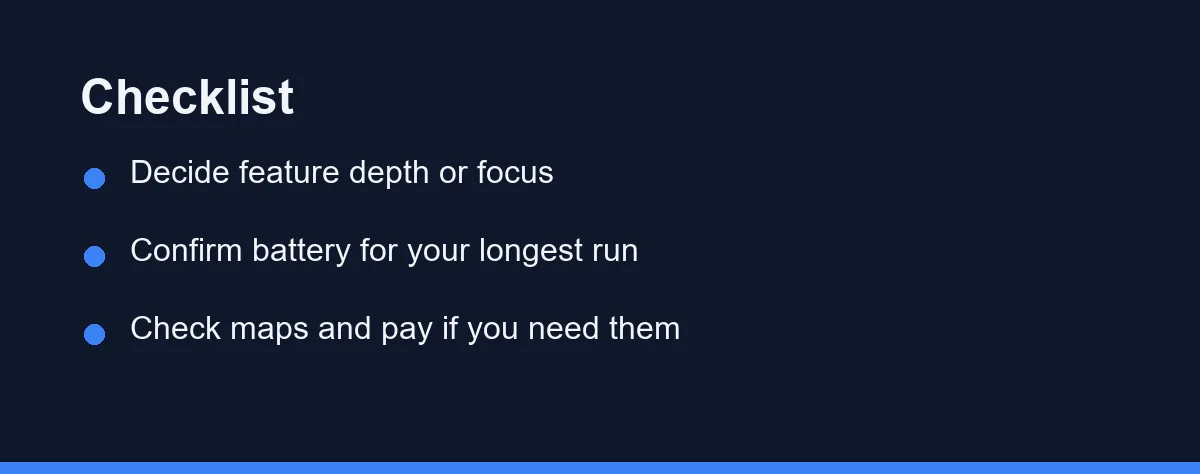
Start with your longest planned day, check the active GPS figure for that exact model, and only then argue about features. That single question eliminates half the lineup on both sides.
Pick Garmin for maximum features and navigation, and pick Coros for long battery and a clean training focus. Confirm current model specs and prices on each official site, then trust the plan more than the hardware.
Battery figures shift again with the satellite mode you choose. See multi-band versus single-band GPS for the hours each mode costs and where the extra frequency actually helps.
If the satellite menu itself is the confusing part, what GNSS means on a watch explains each option and the battery hours behind it.
Daily step totals raise a separate question, since a wrist and a pocket rarely agree. Why your watch and phone show different step counts explains the gap and which figure to keep.
FAQ
What is the difference between Garmin and Coros for running?
Garmin offers a wide lineup from entry running watches to high-end multisport models, with a large app and maps ecosystem. Coros focuses on a smaller, running and endurance-first lineup known for long battery life and simple menus. Garmin suits people who want the biggest feature set, while Coros suits runners who want battery and focus over extras.
Which has better battery life, Garmin or Coros?
Battery life depends on the exact model and GPS mode, so compare the specific watches you are considering. Coros built its reputation partly on very long battery life for endurance events. Garmin's higher-end models also last a long time, while entry models last less. Check each watch's stated GPS battery figure on the official site before buying.
Are Garmin and Coros good for marathon training?
Both brands support structured workouts, interval training, and training-load metrics that help you plan sessions. Garmin adds a larger third-party app store and detailed maps on premium models. Coros keeps its training tools focused and easy to navigate. For marathon plans, either brand can guide pacing and recovery.
Do Garmin and Coros work with both iPhone and Android?
Neither brand locks you into a phone platform, since both work with iPhone and Android through their own apps. Music, contactless pay, and maps vary by model and brand, so confirm those on the specific watch page. If ecosystem apps matter most, Garmin's catalog is larger. If simplicity matters most, Coros feels lighter.
Which is better for a beginner runner, Garmin or Coros?
Beginners can do well with either brand, since both offer approachable entry models and guided workouts. Coros is often praised for a simple menu that new runners find easy to learn. Garmin's entry watches add more features but a slightly steeper learning curve. Pick the one whose interface you find less intimidating.
Some links may be affiliate links. We may earn a commission at no extra cost to you.
This article was written with AI assistance. It is researched and fact-checked, not based on personal hands-on testing unless explicitly stated.
Comments
Post a Comment